Speculāris Operations LLC
Concept Brief — Confidential
Mass Driver Network
Speculāris — On the cutting edge
Mass Driver Network — Four Sites. One Logistics Architecture.
Earth is behind us — always.

The MASS
DRIVER

No rocket fuel. No exhaust. No consumables. Electromagnetic launch from four permanent installations — Japan, the Swiss Alps, Pikes Peak, and the lunar south pole. The same physics. Four environments. One continuous pipeline from ground to orbit to L4.

Launch sites
4
Earth + Moon
Propellant consumed
Zero
Per launch
Lunar gravity
0.165g
Shackleton crater rim
Power source
FPP
Fusion — all sites
Japan Prefecture — Primary Earth Launch Facility
·
Swiss Alps — European Command Bunker
·
Pikes Peak — Colorado Relay Station
·
Lunar South Pole — Shackleton Crater Rim
·
Japan Prefecture — Primary Earth Launch Facility
·
Swiss Alps — European Command Bunker
·
Pikes Peak — Colorado Relay Station
·
Lunar South Pole — Shackleton Crater Rim
The Technology

Electromagnetic
Launch

A mass driver is a linear electromagnetic accelerator. A payload sits in a carrier sled. A sequence of superconducting coils energises in precise succession, accelerating the sled along the track to launch velocity without combustion, without exhaust, without propellant of any kind.

The power comes from the grid, not the payload. Every launch draws from a capacitor bank charged by the site fusion power plant. The driver resets and charges while the next payload is loaded. Continuous, repeatable, scalable.

On Earth, mass drivers operate at high altitude to minimise atmospheric drag on the exiting payload. Japan and Pikes Peak exploit mountainous terrain. The Swiss bunker is buried in bedrock — its barrel emerges above the treeline into thin Alpine air. On the Moon there is no atmosphere at all. The lunar driver launches directly to orbital insertion velocity with no drag losses whatsoever.
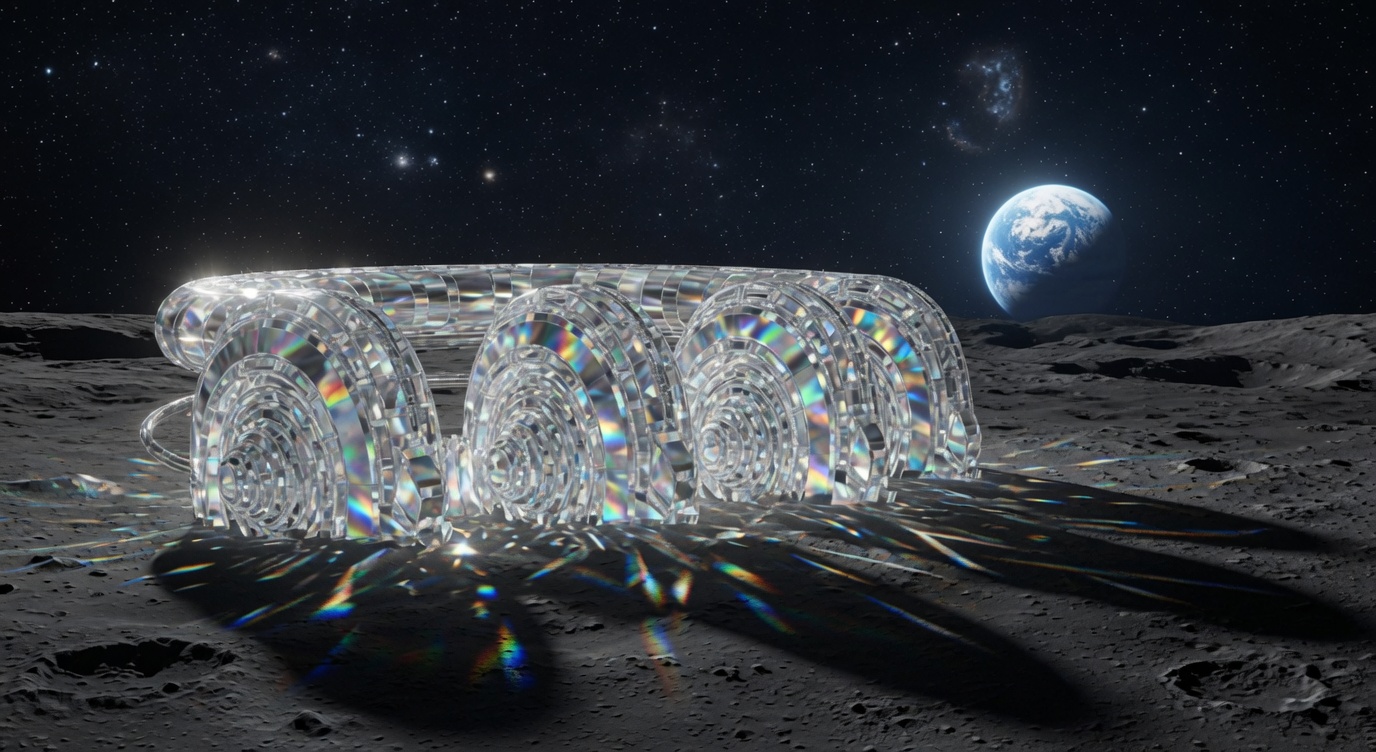
Lunar mass driver coil array with Earth rising
Lunar south pole — Shackleton crater rim — Earth rising
01
Japan
Pacific — Primary Earth Site
The primary terrestrial launch facility. High-altitude Pacific location selected for minimal atmospheric column above the barrel exit, favourable orbital geometry for L4 trajectory insertion, and seismic isolation from active fault zones. FPP fusion power plant on site. The first driver constructed. The template for all Earth-based installations.
Earth Launch
02
Swiss Alps
Central Europe — Command Bunker
Bedrock-buried installation in the Swiss Alps with the barrel emerging above the high Alpine snowline. Serves as the European command and data centre for the Speculāris network — the hardened nerve centre of the L4 comms relay chain. Operational depth and political neutrality make Switzerland the natural choice for a permanent infrastructure anchor.
Command + Launch
03
Pikes Peak
Colorado, USA — Relay Station
14,115 feet above sea level. The highest accessible mountain in the contiguous United States provides a natural high-altitude platform for a North American relay and launch station. CNT supercapacitor bank stores fusion output between launches. Paired with the Texas Brownsville ground support facility for crew and logistics operations.
Relay + Launch
04
The Moon
Shackleton Crater Rim — Lunar South Pole
No atmosphere. One-sixth gravity. Permanent sunlight on the rim. The lunar mass driver is the most efficient launch installation in the inner solar system. Zero drag losses. Low escape velocity. Direct injection to lunar orbit for rendezvous with the L4 transport fleet. Built entirely from asteroid-derived materials by Constructor drones. No Earth-launched hardware required after bootstrap.
Lunar Launch
The Lunar Advantage

No Air.
No Drag.
No Limits.

Every kilogram launched from Earth must fight through 100 kilometres of atmosphere. Every chemical rocket carries its own oxidiser — dead mass burning away before the payload ever reaches orbit.

The Moon changes everything. Lunar escape velocity is 2.38 km/s. A mass driver on the rim of Shackleton crater — where near-continuous sunlight powers the fusion plant — can loft canisters of He-3, processed regolith, and manufactured components directly to orbital rendezvous with no propellant at all.

The same crystal CVD diamond and CNT superconducting coil technology manufactured at L4 is what the driver is built from. The factory makes the infrastructure that ships the factory's output.

I
Zero propellant per launch
Energy from the fusion plant. Payload carries no fuel. No mass fraction problem.
II
Built from what it ships
CVD diamond coil forms. CNT superconducting windings. Asteroid iron structural frames. Nothing from Earth.
III
Perpetual operation
No consumables. No exhaust. No wear on moving parts. Maintained by C2 Constructor drones indefinitely.
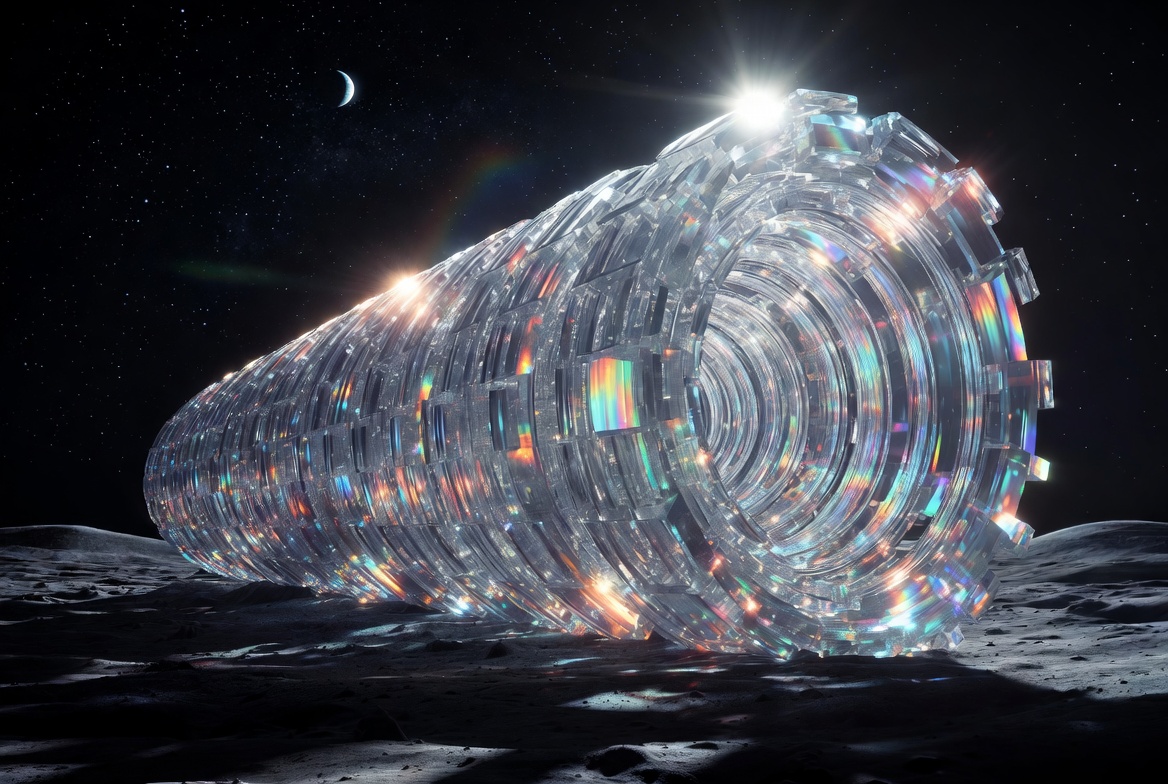
Lunar mass driver barrel pointing toward Earth
Muzzle end — Earth in the background — always
Architecture

How the Pipeline Works

Payload preparation
He-3 canisters, processed regolith, manufactured components, and water canisters are loaded into standardised carrier sleds at the site processing facility. Each sled is DRAD-1 chipped and tracked.
Capacitor bank charge
The CNT supercapacitor bank draws from the on-site FPP fusion plant. Full charge between launches ensures consistent launch energy regardless of site power fluctuation.
Electromagnetic acceleration
Superconducting coils fire in sequence along the barrel. The carrier sled accelerates to launch velocity. On the Moon: direct orbital injection. On Earth: high-altitude atmospheric exit, upper stage circularisation.
Orbital rendezvous
Launched canisters rendezvous with waiting transport ships in orbit. No propulsion required from the canister — the transport ship performs the final docking manoeuvre.
L4 transit
Loaded transports depart for Earth-Sun L4 on fusion drives. Transit: 3–5 months. The mass driver sites are continuously loading the next batch before the previous one clears lunar orbit.
Factory receipt
Canisters arrive at L4. DRAD-1 inventory system logs each item against the manifest. Raw materials enter the factory queue. The pipeline restocks everything the factory consumes.
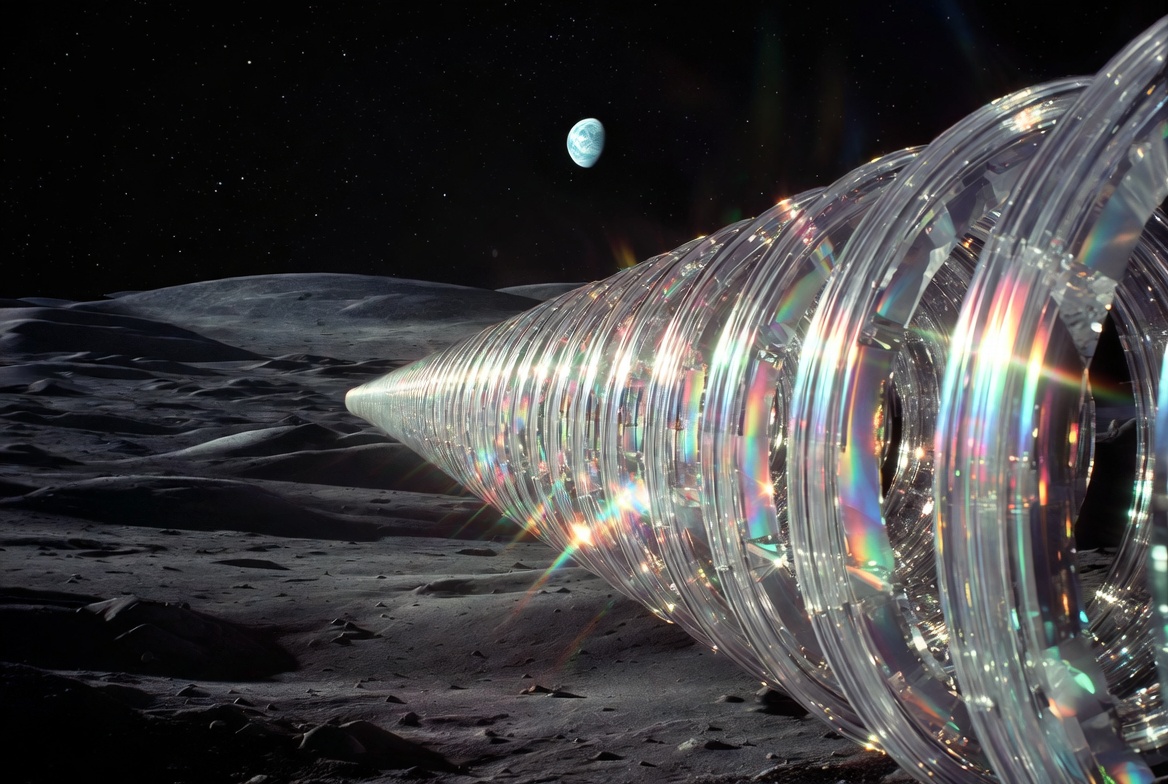
Lunar mass driver installation
Shackleton Crater — Lunar South Pole

Built from
nothing
that came
from Earth.

The lunar mass driver is assembled entirely by Constructor drones using materials produced at L4 — CVD diamond coil forms, CNT superconducting windings, asteroid iron structural frames. Earth-Sun L4 makes the infrastructure that ships its own production back to Earth.

◆   Speculāris Mass Driver Network   ◆   Four Sites   ◆   One Pipeline   ◆