Glaciers that fed rivers for ten thousand years are gone in decades. Aquifers that took millennia to fill are emptied in a generation. Snowpack that arrived every winter has stopped arriving. Two billion people face severe water stress today. Four billion face it at least one month per year. The diplomats are still in session. The aquifers cannot wait.
The ground-based solutions are too slow, too expensive, and require the cooperation of governments that have been disagreeing since 1972. Project Speculāris does not negotiate with geography.
The water programme operates two independent but complementary fleets. Fleet One dips into the atmosphere and drops directly. Fleet Two lifts ancient Antarctic ice and floats it inland. Together they deliver water to every parched coordinate on Earth — mountain snowpack, inland lakes, desert aquifer recharge zones, and failing rivers. No orbital mechanics. No re-entry. No ground infrastructure. Just water, falling where it is needed.
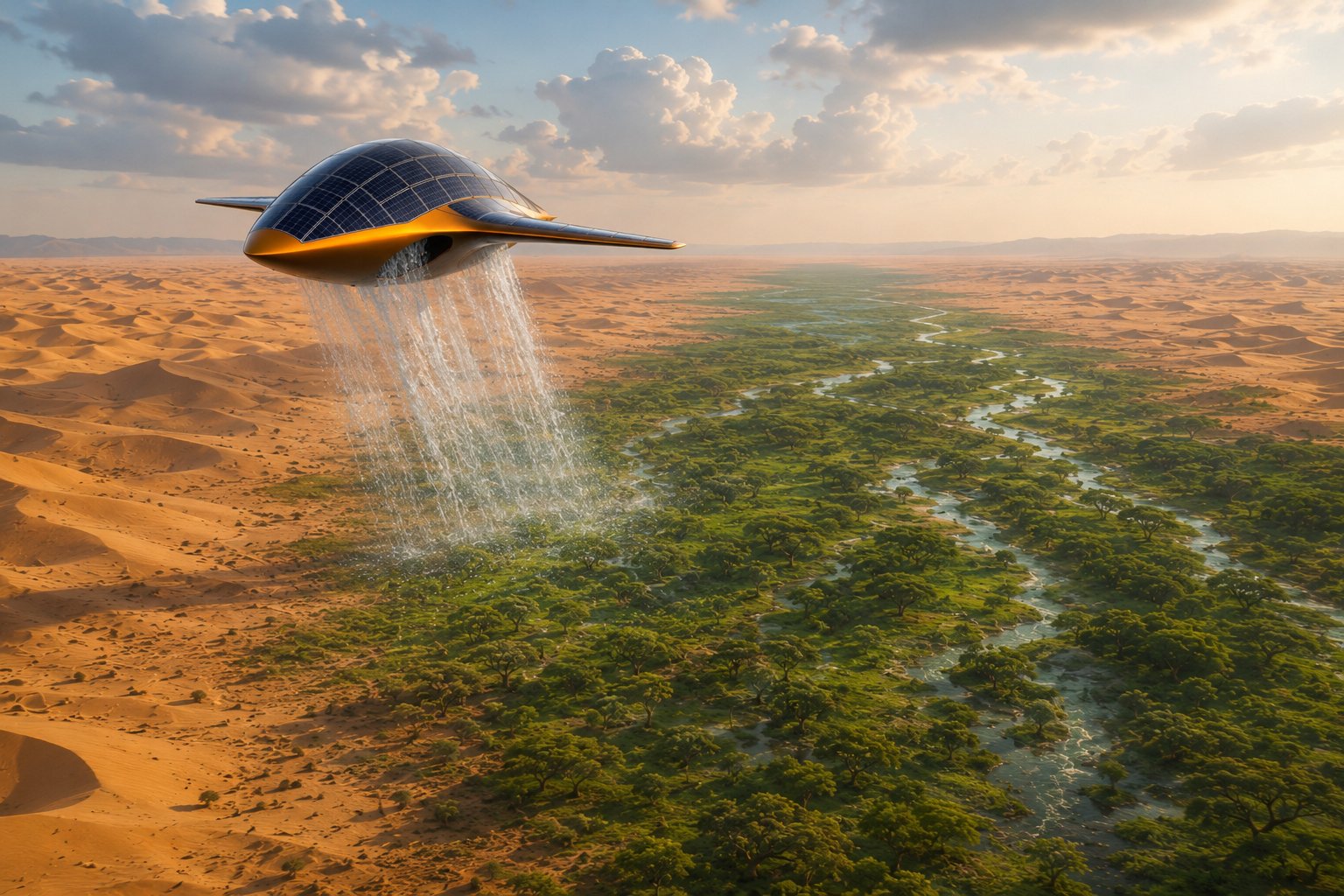
Each ship operates at 10km altitude — the tropospheric moisture layer. Intake scoops harvest water vapour and liquid water from humid air masses. Onboard condensers accumulate a 10,000-tonne payload per cycle. DRAD-1 navigation. Fully autonomous. Drop altitude computed for orographic deposition — the water arrives as natural precipitation. No kinetic impact. No flood. A season's worth of rain, precisely placed.
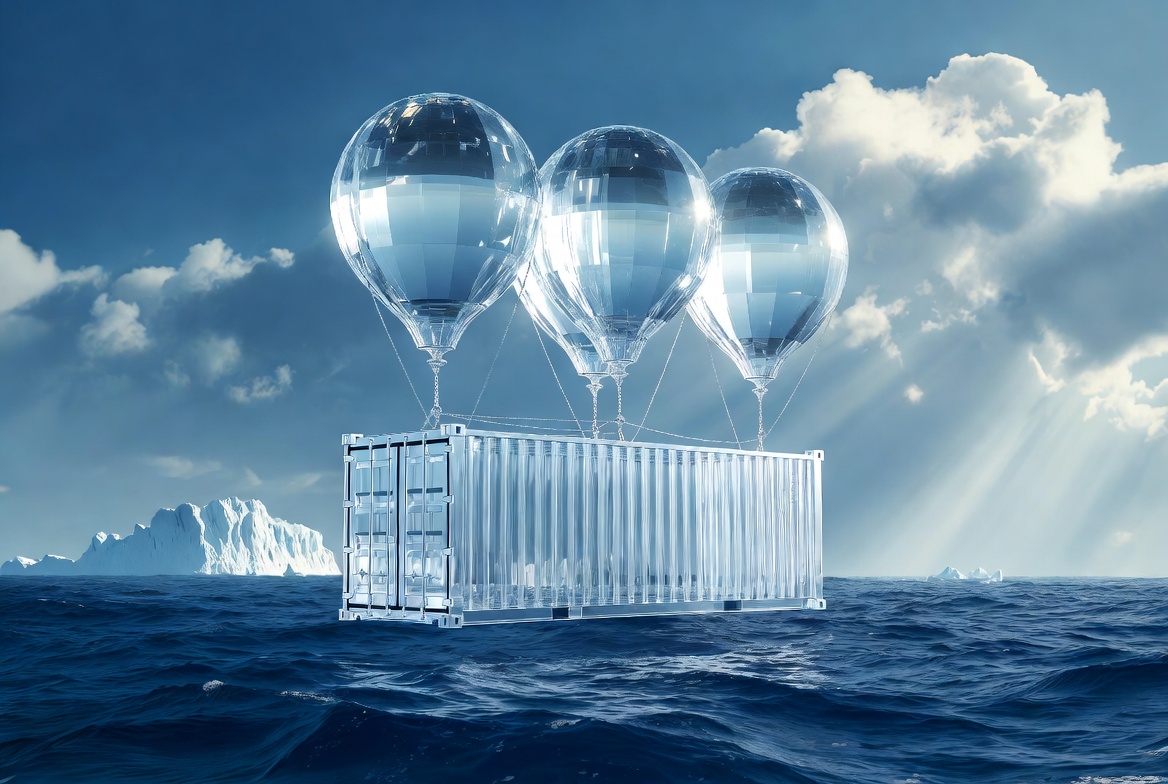
C5 Constructor drones anchor to calved Antarctic icebergs. Heated carbyne wire cutters slice ice blocks into insulated 28,000kg containers. Heavy-XXL 50m graphene dirigibles lift and transit inland on prevailing wind corridors — 6 to 10 days, zero propellant. Solar-powered DRAD-1 navigation steers each container to the target lake. The iceberg is already part of Earth's water inventory. The lake simply receives what the ocean was about to claim.
The hydrological cycle does not need to be repaired — it needs to be replenished. The Speculāris fleet targets the exact points in the system where the deficit is greatest.
Fleet One operates where water is plentiful but misplaced — tropical ocean air masses, equatorial convergence zones, monsoonal moisture corridors. Fleet Two operates where water is solid and stranded — Antarctic calving fronts, glacial outflows bound for the ocean. Both deliver to where water is absent. The fleets are independent, non-competing, and together cover every drought scenario on Earth.
Fleet One targets high-altitude snowpack, glacier deposition, and desert-margin rainfall — precision micro-droplet release that mirrors natural orographic precipitation. Fleet Two targets inland lakes, lowland reservoirs, and agricultural basins — direct ice delivery to the lake surface, zero mechanical complexity at the destination. DRAD-1 runs both fleets. No human is present at any stage of the operation.
The water cycle does not respect national boundaries. Rain does not check a passport. Snow does not file for permits. Neither does the Speculāris fleet.
Thirty ships in polar orbit deliver precipitation to every parched coordinate on the surface of this planet. The Sahara. The Empty Quarter. The Atacama. The cracking riverbeds of California. The vanishing snowpack of the Hindu Kush. Every failing glacier. Every dry aquifer. Every empty reservoir.
We do not ask who owns the drought. We do not negotiate with the heat. We bring water from orbit and we put it where it is needed. The planet will be green again. We are merely accelerating the schedule.
Project Speculāris is the only program in existence that addresses water scarcity with two independent delivery fleets — 1,000 atmospheric scoop ships and 1,000 Antarctic ice dirigibles. Every drought zone on Earth.